April 2026 Automotive Recall Summary: Ford Accounts for 73% of All Affected Vehicles
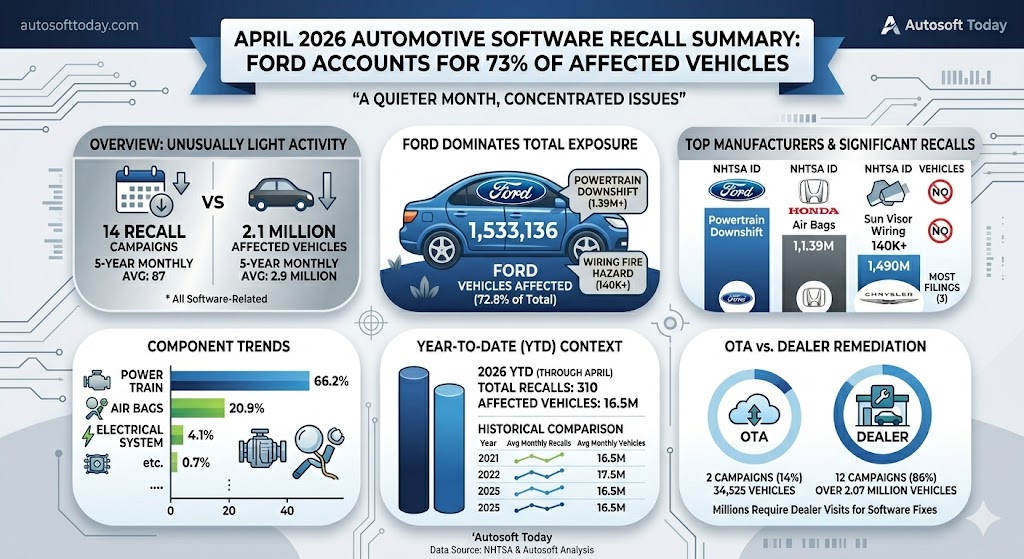
April 2026 brought unusually light software recall activity — 14 campaigns and just over 2.1 million vehicles — making it one of the lower-volume months tracked on this site. As always, this site tracks only software-related recalls; the figures below reflect that subset of NHTSA activity, not total recall volume across all categories. Within that software-recall set, the data tells a concentrated story: two Ford campaigns accounted for 73% of all affected vehicles, continuing Ford’s software woes this year with products in the field.
Overview
This site tracks software-related automotive recalls only. In April 2026, NHTSA recorded 14 software recall campaigns affecting 2,104,830 vehicles. That recall count is 84% below the 5-year monthly average of 87 software campaigns per month, and vehicle exposure is 27% below the 5-year monthly average of approximately 2.9 million vehicles per month.
Of the 14 campaigns, 2 were OTA-eligible covering 34,525 vehicles, meaning the remaining 12 (affecting over 2.07 million vehicles) require dealer visits for remediation. There were no re-recalls in April, a notable contrast to prior months where rework campaigns have added to overall volume.
Most Affected Manufacturer: Ford Motor Company
Ford Motor Company issued 2 recalls in April, affecting a combined 1,533,136 vehicles — 72.8% of the month’s total exposure. Both campaigns were large-scale and involved distinct safety risks: an unexpected powertrain downshift and a sun visor wiring fire hazard.
No other manufacturer came close to Ford’s footprint. Honda was the second-largest contributor with a single airbag recall covering 440,830 vehicles, and Chrysler (FCA US, LLC) filed 3 campaigns totaling 85,860 vehicles — the most recall filings of any manufacturer in April.
Significant Recalls (≥ 100,000 Vehicles)
Three campaigns crossed the 100,000-vehicle threshold in April:
| NHTSA ID | Manufacturer | Subject | Vehicles | OTA |
|---|---|---|---|---|
| 26V237000 | Ford Motor Company | Unexpected Downshift Can Cause Loss of Control | 1,392,935 | No |
| 26V227000 | Honda (American Honda Motor Co.) | Air Bags May Deploy Unexpectedly | 440,830 | No |
| 26V238000 | Ford Motor Company | Sun Visor Wiring May Cause Fire | 140,201 | No |
The Ford powertrain recall (26V237000) is the month’s standout: 1,392,935 vehicles subject to an unexpected downshift that can cause loss of vehicle control is a significant safety exposure, and the software root cause means dealer visits rather than an over-the-air fix. The Honda airbag campaign (26V227000) follows a similar dealer-remediation path, covering 440,830 vehicles where airbags may deploy unexpectedly — a category that historically carries high urgency given the injury risk.
Component Trends
The month’s component breakdown was heavily concentrated in two categories:
| Component | Recalls | Vehicles Affected | % of Month Total |
|---|---|---|---|
| POWER TRAIN | 1 | 1,392,935 | 66.2% |
| AIR BAGS | 1 | 440,830 | 20.9% |
| ELECTRICAL SYSTEM | 4 | 86,310 | 4.1% |
| EXTERIOR LIGHTING | 4 | 36,699 | 1.7% |
| VISIBILITY | 1 | 6,077 | 0.3% |
POWER TRAIN and AIR BAGS together account for 87% of April’s total affected vehicles — an unusually skewed distribution driven by the two large campaigns. The four ELECTRICAL SYSTEM recalls, while smaller individually, reinforce a persistent pattern across recent months where embedded software governs wiring, power distribution, and charging logic in ways that generate ongoing compliance gaps.
EXTERIOR LIGHTING accounted for four separate recalls, all relatively small in vehicle count (36,699 combined), but the recurring nature of this category — typically tied to FMVSS compliance for turn signals, brake lights, and reverse indicators — suggests software-controlled lighting modules continue to be an integration challenge across multiple manufacturers.
Year-to-Date Context
Through April 2026 (4 months elapsed), the industry has recorded 310 total recalls affecting 16,529,135 vehicles, including 54 software recalls covering 9,373,927 vehicles.
For comparison, the 5-year monthly averages from prior years:
| Year | Annual Recalls | Avg Monthly Recalls | Annual Vehicles | Avg Monthly Vehicles |
|---|---|---|---|---|
| 2025 | 997 | 83 | 31,284,720 | 2,607,060 |
| 2024 | 1,073 | 89 | 35,020,506 | 2,918,376 |
| 2023 | 1,000 | 83 | 39,757,940 | 3,313,162 |
| 2022 | 1,051 | 88 | 32,270,783 | 2,689,232 |
| 2021 | 1,094 | 91 | 35,259,175 | 2,938,265 |
April’s 14 recalls sit well below any prior-year monthly average. Whether this represents a genuine slowdown in NHTSA filing activity, a lag in manufacturer reporting, or simply normal month-to-month variation will become clearer as the year progresses. The YTD pace of 77.5 recalls per month (310 ÷ 4) is tracking modestly below recent annual averages.
View the full charts and year-to-date data
OTA vs. Dealer Remediation
Of the 14 software recall campaigns in April, just 2 (14%) were OTA-eligible, covering 34,525 vehicles. The remaining 12 campaigns — including the two large Ford campaigns and the Honda airbag recall that together account for 94% of the month’s vehicle exposure — all require dealer visits.
For consumers, that means scheduling service time for what are software-fixable safety issues. For manufacturers, it means relying on dealer capacity and completion rate reporting to close out campaigns affecting millions of vehicles. The low OTA rate in April reinforces that even as software-defined vehicle architectures expand, the ability to push certified safety fixes wirelessly remains limited to a subset of the fleet and a subset of issue types.